S e l a h
A learning series for people at the edge of frameworks.
[Interest Form here and at the bottom of this page]
The Encounter
Why you are here…
S e l a h is for people doing serious work — justice, organizing, faith, education, healing, ceremony — who have arrived at the sensation that their frameworks, however good, are no longer adequate to the moment. Not burned out. Not apathetic. At the edge of what they know.

[Buy Selah here]
What This Is
Why this shape, and not another?
S e l a h uses a method from the Talmudic tradition called teiku — structured inquiry where the refusal of resolution is not failure but method. Jacob wrestles the angel all night and walks away limping, not victorious. The rabbis preserve disagreement across centuries rather than flattening it into consensus. Job demands answers and receives a whirlwind. Shattered tablets are placed reverently in the arc.
This is not a Jewish program welcoming guests from other traditions. It is a cross-tradition encounter that draws on Hebraic wisdom as a living world lineage — the way it also draws, through Báyò and through the people in the room, on Yoruba cosmology, Buddhist practice, Sufi poetry, Indigenous ceremony, and whatever else participants carry with them. We share progressive values while simultaneously questioning whether the progressive framework itself has become its own kind of solutionism. It’s not anti-activism, but a willingness to ask what comes after the moment when deeper commitment itself stops being enough.
How It Works
So what does that actually look like in practice?
Imagine three texts on a page:
• A passage from Báyò Akomóláfé’s Selah (Ayin Press, 2026) — philosophical fragments from a Yoruba posthumanist thinker whose work interrupts familiar frameworks of crisis and response. The book is the anchor text for the series, not because it has the answers, but because it holds the questions with unusual precision.
• A text brought by someone from their own wisdom tradition or practice — something they are still wrestling with.
• A text from the Hebrew prophetic and midrashic tradition — one of the oldest practices of sitting with what does not resolve.
You study them in pairs. Not discussion. Not debate. Close reading in relationship, with friction. Each session ends with a single unresolved line to carry into the week.
Participants study these three texts in hevrutah — paired encounter. Not discussion or debate, but close reading in relationship, with friction, and guided by a specific prompt designed to surface genuine difference. The prompts carry the weight of the present moment: the questions we are actually living inside right now. The point is the encounter in the overlap, at the edge of frameworks.
Each session ends with a fragment carried forward — one unresolved line to take into the week.
Where This Comes From
This all comes from nowhere…
S e l a h grows out of a conversation and a collaboration. In 2023, Rabbi Nate DeGroot and Báyò Akomóláfé published a Talmudo-poetic dialogue in Ayin Press’s Teiku column — an exchange structured by teiku, the Talmudic notation for disputes that must not be resolved. Báyò has long drawn on Hebraic tradition in his own work: Jacob’s limp, the Book of Job, the rupture at the beginning of creation. That conversation became the seed.
Adam Sher conceived and developed the S e l a h learning series from inside The Shalom Center’s Cohort א — a yearlong inquiry into Jewish post-activism. Through Ayin Press, he also midwifed Báyò’s book into publication. His work with Báyò over many years — including Qarrtsiluni, a paraphilanthropic experiment in treating encounter itself as a form of giving — shapes the program’s conviction that the economic and relational structures of learning are not separate from the learning itself.
The Shalom Center, which hosts S e l a h , has spent more than forty years at the intersection of Jewish wisdom and prophecy. Its founder, Rabbi Arthur Waskow, died in October 2025. Nate, as Waskow’s successor, and Adam, as a board and cohort member, are building S e l a h together — carrying that lineage forward by pointing it outward, into encounter with the widest possible room.
The Details
If any of this is pulling at you:
Format: 60-minute monthly sessions, online.
Timeline: Beginning winter 2026.
Registration: To be announced.
Fill out the interest form below to be notified when registration launches.
Note: This is not a cohort. There is no application process. You need no particular faith or wisdom tradition to participate. You may come to one session or the whole series. Please come as you are. There is no background reading required.
Interest Form
While registration for this learning series is not yet open, fill out the form below and we’ll be in touch when we’re ready to launch!
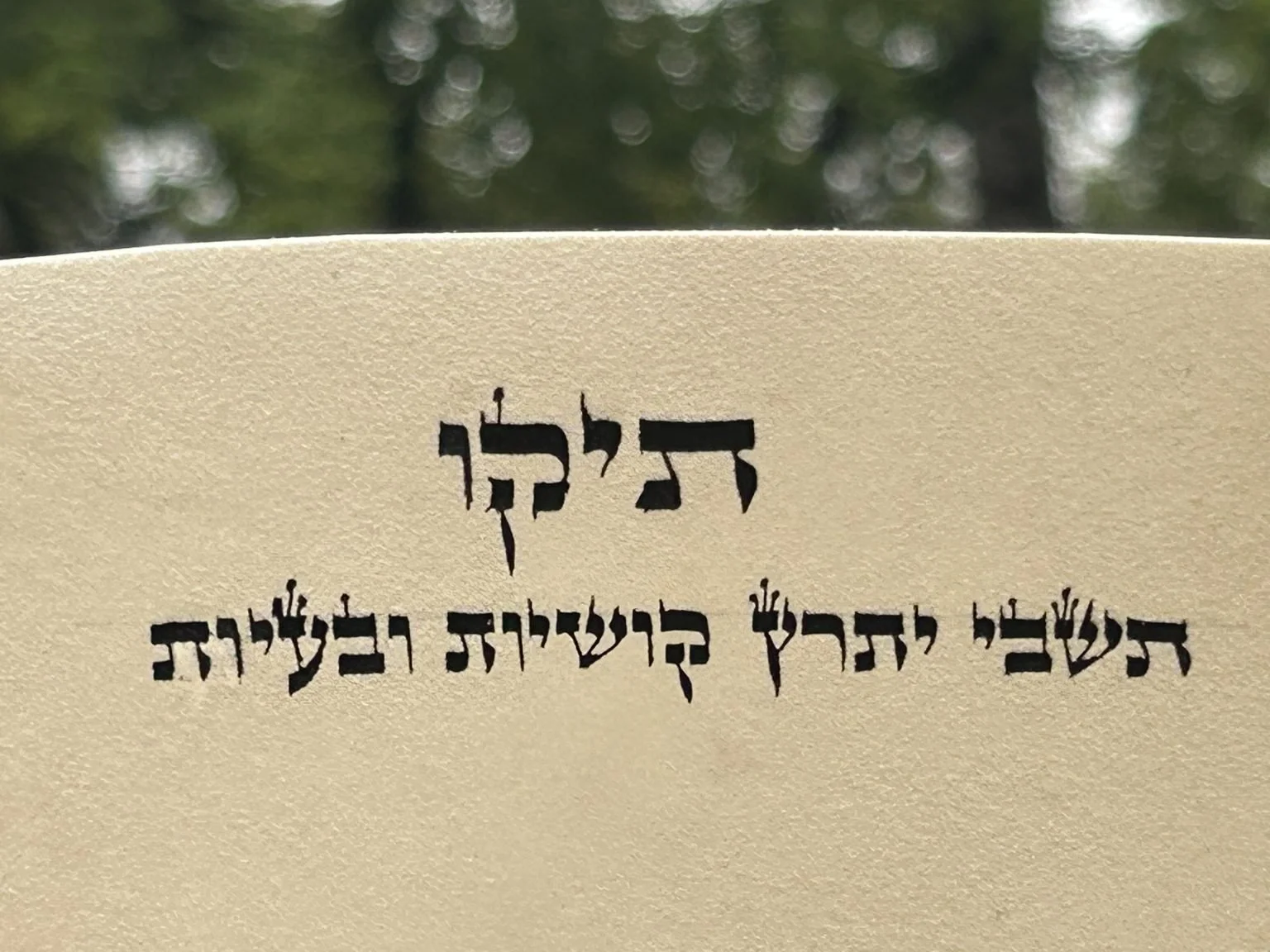
Some say that “teiku” is an anagram for “tishbi yetaretz kushiyot u-bayot“—”the Tishbite (Eliyahu ha-Navi) will solve all questions and puzzles (in the World to Come).” Calligraphy by Julie Seltzer, Photo by Adam Sher